Welcome back guys! Hope you all had a wonderful holiday and if you don't celebrate the holidays hope you had a nice week. Heh.
Anywho, so I decided since I'm feeling all festive and it's nearly the end of the year I wanted to change pace just for this post to talk about something a bit more positive instead of berating everyone again this week. So instead of giving advice I'm going to talk about my top five comics of 2012. These are all excellent titles that you all should be reading.
NOTE: These are in no particular order because I really couldn't choose, I love them all for different reasons.
THE CREEP by John Arcudi & Jonathan Case
The Creep follows private detective Oxel "The Creep" Karnhaus as he investigates a double teen suicide. With Arcudi at the helm I expected a more supernatural type tale but was really surprised to find a more straight-forward mystery tale. Well, straight-forward isn't quite the right word for any good mystery story, but you know what I mean. Arcudi really weaves a wonderful tale here and really nails the noir thing. Jonathan Case, god, what can I say about Jonathan Case that doesn't sound like fan-boy geeking out? I fell in love with his work with Dear Creature (which, if you haven't read, please, go out and grab a copy ASAP.) Case just nails every aspect of this book from Oxel's frustrations, to the profound sadness surrounding the whole story. This is truly a comics masterwork that I could not recommend more.
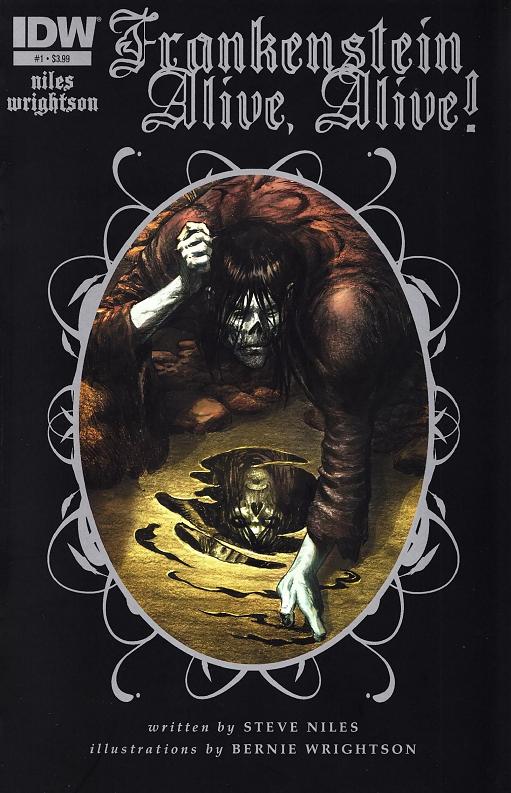
FRANKENSTEIN ALIVE, ALIVE! by Steve Niles & Bernie Wrightson
Some of you might not know this, but I love Frankenstein's monster. Seriously, from the Karloff films to Shelley's novel to Christopher Lee as the monster in the Hammer flicks. I just... ugh... it's unhealthy. I mean, c'mon, it's why I created Mr. Frank. Anyway, Frankenstein Alive, Alive! is just so wonderful I can't even express. You'd be hard-pressed to find two creators in comics who love and respect the character more than Niles and Wrightson. Niles is a professed horror nut and Wrightson illustrated Shelley's novel back in the 80's and as far as I'm concerned his interpretation is the monster. Alive, Alive starts off with Frankenstein's monster working at a carnival sideshow then begins to fill in the gaps between the end of the novel and where we are first reintroduced to the character. It's lovely, sad, beautiful, and just... great. I am thoroughly looking forward to Issue #3.
ANATHEMA by Rachel Deering, Chris Mooneyham, & Wes St. Claire
Anathema is a tale of Mercy Barlowe who becomes a werewolf to avenge the death of her lover Sarah and to stop an ancient evil from being resurrected by a cult of ravens. First and foremost, you would never know that this is Deering's first comic. The writing is so polished and smart that you'd think she was a seasoned pro. Anathema is visceral, heart-breaking, and sexy as all hell. Mooneyham (the artist for #1 & #2) and Wes St. Claire (#3) also add a nice layer of polish to this already exceptional book. If you love werewolves, Hammer horror movies, or just a well-crafted horror comic, I cannot recommend this more.
HELLBOY IN HELL by Mike Mignola
Those of you who know me, know I am a massive Hellboy fan as well as a huge fan of Mignola in general, so it shouldn't surprise you that even with only one issue out that this would land on my list. Hellboy is dead (in case you didn't know) and has been sent back to Hell and has to face off against an old foe and make a new (old) ally. It is incredibly refreshing to see Mignola return to art duties on ol' Red. Don't get me wrong, I adore Duncan Fegredo and Richard Corbin drawing Hellboy, but nobody does it like Mignola. With him back on the book, it seems like all is right in the universe . Also, nobody draws strange Lovecraftian monstrosities like Mignola can... okay, well, maybe Guy Davis, but whatever. MIGNOLA IS DRAWING HELLBOY AGAIN. That is all you need to know.
DEADHORSE by Eric Grissom & Phil Sloan
Deadhorse is a mystery comic that follows Pike who receives a mysterious key from his mysterious father and has to go the mysterious town of Deadhorse, Alaska and and... well... whoa... that's a lot of mystery. Hang on. Deadhorse is delightfully charming, funny, smart, and mysterious. It's a wonderfully written comic that just wrapped up its first story arc "Dead Birds" with Issue #6. Grissom's writing is funny, suspenseful, and engrossing while Sloan just slays the art with this. His brush and ink style may at first seem a bit cartoony but hang in there, it totally fits the tone of the book and really just makes it even better (which is pretty crazy considering how great the writing is.) Again this comes from a first time comics writer which just blows my mind. I would have killed to have come out of the gate this polished. Truly a wonderful comic book.
HONORABLE MENTIONS:
BEWARE by Mike Perkins & Will Perkins, FUBAR: SUMMER SPECIAL by Jeff McComsey, Chuck Dixon, Jim McMunn & more, VIC BOONE: MALFUNCTION MURDER TPB by Shawn Aldridge, Geoffo, and more, and THE STRANGE TALENT OF LUTHER STRODE by Justin Jordan and Tradd Moore.
Well, that just about covers it guys. Have a happy New Year and see you guys next week!
A little blog about how to write comic scripts that won't enrage your artists!
Wednesday, December 26, 2012
Monday, December 17, 2012
Panel 2: Clutter
Welcome back to How NOT to Write Comics! This time around I'm going to discuss what I fondly refer to as "Clutter." Essentially, what this comes down to is that a comic page has limited space since we're dealing with a real physical surface and it becomes all too easy to fill up that space and more quickly than you'd think!
There are two sub-sections to this discussion so I'm going to tackle each one separately. The first is Planel Clutter. Captions are great, you can use them to tell dates, times, locations, or even a character's thoughts or to offer narration. However, it's really easy to get carried away, especially if you're tackling something along the lines of a noir or detective story.
I've seen it more times than I can count but you often see someone has five panels on a page, they have eleven captions, seven lines of dialogue three sound effects, and want actual action in the panels. That just isn't going to work. At all. And it's a quick way to make your artist want to murder you in your sleep. What it comes down to realizing what will legitimately fit on a page. If you have to have a lot of captions on a particular page, keep the action and dialogue to a minimum, particularly in caption heavy panels.
My best recommendation for a writer who is struggling with this is to thumbnail out your pages complete with actions, word bubbles, sound effects, and caption boxes. (If you don't know, thumbnails are essentially small-scale sketches of comic panels.) But thumbnailing your page will give you a very real idea of what you can and cannot fit. And it doesn't need to be pretty... seriously, it can look like utter crap, but it'll help you understand the limited real estate that is the comic book page. And NO CHEATING. You can't put a little tiny box where a three sentence caption is going to go.
Another important thing to remember is that comics is a visual medium. If you're essentially using captions to tell your story, you're doing it wrong. But I will dedicate an entire post to this problem in the future.
The other half of this discussion is Page Clutter. It has the same principles as Panel Clutter but on a larger scale. Essentially, this is more or less about panel count, size, and content. Personally, I try to keep my panel count to six or less per page. Occasionally, if I've got a few very small panels I may sneak in seven or maybe eight. I don't think I've ever gone above nine, unless we were dealing with a larger format like the one-page Igor story "The Familiar" which was printed at a larger scale of 10.5" x 16" as opposed to your regular 6.625" x 10.25" comic page.
Also it's important to realize that more panels equals smaller panels. So the more panels you've got per page the less imperative those actions ought to be. In comics we often equate panel size with event importance. The bigger the panel, the more important the action/event. So, don't have some ground-breaking moment in a little tiny panel on a page filled with other little tiny panels.
Realize, too, that you can't have four people in a small panel fighting or performing elaborate actions or even having a lengthy discussion or sprawling landscapes in panels of this size. The smaller your panels get the less you can do with them. Also you can't ask for six wide panels on a page, unless you want them all to be really, really short. Again this is all the sort of thing that can be helped by thumbnailing your pages.
Well, I think I've hit all the points that I intended for this posting. Next week, the post won't be going up on Monday as it's Christmas Eve and I know a lot of you will be busy so next week's post will go up Wednesday December 26th to account for that. Have a wonderful and safe holiday and I'll see you all then!
There are two sub-sections to this discussion so I'm going to tackle each one separately. The first is Planel Clutter. Captions are great, you can use them to tell dates, times, locations, or even a character's thoughts or to offer narration. However, it's really easy to get carried away, especially if you're tackling something along the lines of a noir or detective story.
I've seen it more times than I can count but you often see someone has five panels on a page, they have eleven captions, seven lines of dialogue three sound effects, and want actual action in the panels. That just isn't going to work. At all. And it's a quick way to make your artist want to murder you in your sleep. What it comes down to realizing what will legitimately fit on a page. If you have to have a lot of captions on a particular page, keep the action and dialogue to a minimum, particularly in caption heavy panels.
My best recommendation for a writer who is struggling with this is to thumbnail out your pages complete with actions, word bubbles, sound effects, and caption boxes. (If you don't know, thumbnails are essentially small-scale sketches of comic panels.) But thumbnailing your page will give you a very real idea of what you can and cannot fit. And it doesn't need to be pretty... seriously, it can look like utter crap, but it'll help you understand the limited real estate that is the comic book page. And NO CHEATING. You can't put a little tiny box where a three sentence caption is going to go.
Another important thing to remember is that comics is a visual medium. If you're essentially using captions to tell your story, you're doing it wrong. But I will dedicate an entire post to this problem in the future.
The other half of this discussion is Page Clutter. It has the same principles as Panel Clutter but on a larger scale. Essentially, this is more or less about panel count, size, and content. Personally, I try to keep my panel count to six or less per page. Occasionally, if I've got a few very small panels I may sneak in seven or maybe eight. I don't think I've ever gone above nine, unless we were dealing with a larger format like the one-page Igor story "The Familiar" which was printed at a larger scale of 10.5" x 16" as opposed to your regular 6.625" x 10.25" comic page.
Also it's important to realize that more panels equals smaller panels. So the more panels you've got per page the less imperative those actions ought to be. In comics we often equate panel size with event importance. The bigger the panel, the more important the action/event. So, don't have some ground-breaking moment in a little tiny panel on a page filled with other little tiny panels.
Realize, too, that you can't have four people in a small panel fighting or performing elaborate actions or even having a lengthy discussion or sprawling landscapes in panels of this size. The smaller your panels get the less you can do with them. Also you can't ask for six wide panels on a page, unless you want them all to be really, really short. Again this is all the sort of thing that can be helped by thumbnailing your pages.
Well, I think I've hit all the points that I intended for this posting. Next week, the post won't be going up on Monday as it's Christmas Eve and I know a lot of you will be busy so next week's post will go up Wednesday December 26th to account for that. Have a wonderful and safe holiday and I'll see you all then!
Monday, December 10, 2012
Panel 1: Formatting
Welcome to How NOT to Write Comics! Our first post is going to cover script formatting. This ought to be a pretty short one, but this is so vital.
I've seen so many scripts that are just an utter nightmare to read, even as a comics writer I look at them and just can't parse out what's supposed to go where. It's one thing to write a mess of script for yourself, but when you're writing for another artist, you need to keep it clean and concise. And, honestly, it's just good to keep solid legible scripts on hand. You never know when an artist is going to want to see a writing sample before agreeing to work with you. Here's an example of what NOT to do.
PAGE
Panel: Chuck walks down the street. The date is January 7, 2012.
Panel: He bumps into a woman walking the opposite direction and says, "Hey watch it!" The woman says, "What's wrong with you?"
Panel: Chuck spins around hearing a loud crash sound. There has been an accident. He think, "What was that?!"
PAGE
Panel: Blah blah blah...
Now, I just made that up and honestly, it's not even that bad compared to some of the crap that I've seen. (Okay, the script itself is really bad, but we're talking formatting here.) Below I've written out an example of a great way to format your pages that fixes everything wrong with the nonsense above.
CHUCK'S BAD DAY
WRITTEN BY KYLE J. KACZMARCZYK
DRAWN BY GOD HELP YOU
PAGE 1 (3 Panels)
Panel 1: Chuck is walking down the street.
CAPTION:
January 7, 2012
Panel 2: He bumps into a woman walking in the opposite direction.
CHUCK:
Hey, watch it!
WOMAN:
What's wrong with you?
Panel 3: Chuck spins around, there has been an accident.
SFX:
CRASH
CHUCK (CAP):
What was that?!
[Page Break]
PAGE 2 (4 Panels)
Panel 1: Blah blah blah... (you get the point)
Descriptions, dialogue, and captions ought to be written out regularly unless the character is yelling in which case you can get away with all caps. Sound effects on the other hand ought to be in caps unless they're supposed to be very quiet sounds. But usually it's going to be stuff like BOOM or WHAM. You can also use FOOTNOTE as well, which I'm fond of when referencing something kind of obscure. Just make sure you put an * in your caption or dialogue to con-notate that a footnote will appear.
Also, it's important to put your captions, dialogue, etc. in the order you wish them to appear on the panel. I know that sounds pretty obvious, but you'd be surprised how often I've lettered a panel only to find out a caption was supposed to go somewhere else. Also it gives the artist a good idea where to leave room for these things on a panel.
Another important point is that one comic page should equal one script page. If your page runs over that's okay, but make sure you still start the next comic page on the next script page. So even if comic page one runs on to script page two make sure comic page two starts on script page three. Since you've put a panel count at the top of your page, it will avoid any confusion. This essentially just keeps the script from appearing too cluttered and avoids any confusions as to where one page ends and another begins.
Well, that about covers it. If you'd like a more in depth breakdown and essentially know where I got this from you can download this template from Dark Horse comics in either Microsoft Word or PDF format. This was a massive help for me.
Thanks for reading and see you next week!
I've seen so many scripts that are just an utter nightmare to read, even as a comics writer I look at them and just can't parse out what's supposed to go where. It's one thing to write a mess of script for yourself, but when you're writing for another artist, you need to keep it clean and concise. And, honestly, it's just good to keep solid legible scripts on hand. You never know when an artist is going to want to see a writing sample before agreeing to work with you. Here's an example of what NOT to do.
PAGE
Panel: Chuck walks down the street. The date is January 7, 2012.
Panel: He bumps into a woman walking the opposite direction and says, "Hey watch it!" The woman says, "What's wrong with you?"
Panel: Chuck spins around hearing a loud crash sound. There has been an accident. He think, "What was that?!"
PAGE
Panel: Blah blah blah...
Now, I just made that up and honestly, it's not even that bad compared to some of the crap that I've seen. (Okay, the script itself is really bad, but we're talking formatting here.) Below I've written out an example of a great way to format your pages that fixes everything wrong with the nonsense above.
CHUCK'S BAD DAY
WRITTEN BY KYLE J. KACZMARCZYK
DRAWN BY GOD HELP YOU
PAGE 1 (3 Panels)
Panel 1: Chuck is walking down the street.
CAPTION:
January 7, 2012
Panel 2: He bumps into a woman walking in the opposite direction.
CHUCK:
Hey, watch it!
WOMAN:
What's wrong with you?
Panel 3: Chuck spins around, there has been an accident.
SFX:
CRASH
CHUCK (CAP):
What was that?!
[Page Break]
PAGE 2 (4 Panels)
Panel 1: Blah blah blah... (you get the point)
Descriptions, dialogue, and captions ought to be written out regularly unless the character is yelling in which case you can get away with all caps. Sound effects on the other hand ought to be in caps unless they're supposed to be very quiet sounds. But usually it's going to be stuff like BOOM or WHAM. You can also use FOOTNOTE as well, which I'm fond of when referencing something kind of obscure. Just make sure you put an * in your caption or dialogue to con-notate that a footnote will appear.
Also, it's important to put your captions, dialogue, etc. in the order you wish them to appear on the panel. I know that sounds pretty obvious, but you'd be surprised how often I've lettered a panel only to find out a caption was supposed to go somewhere else. Also it gives the artist a good idea where to leave room for these things on a panel.
Another important point is that one comic page should equal one script page. If your page runs over that's okay, but make sure you still start the next comic page on the next script page. So even if comic page one runs on to script page two make sure comic page two starts on script page three. Since you've put a panel count at the top of your page, it will avoid any confusion. This essentially just keeps the script from appearing too cluttered and avoids any confusions as to where one page ends and another begins.
Well, that about covers it. If you'd like a more in depth breakdown and essentially know where I got this from you can download this template from Dark Horse comics in either Microsoft Word or PDF format. This was a massive help for me.
Thanks for reading and see you next week!
Thursday, December 6, 2012
Welcome aboard!
Hello, hello...
If you don't know who I am, I'd like to introduce myself. My name is Kyle J. Kaczmarczyk. I'm an independent New York Times best selling comic book writer and creator, best known for my work on the WWII zombie anthologies FUBAR: European Theater of the Damned, FUBAR: Empire of the Rising Dead, and FUBAR: American History Z, as well as being the co-creator and writer for Igor: Occult Detective, published by 215Ink. I've been making comics for over nine years starting off as a writer/artist combo and recently moving on to being strictly a writer.
I'm starting this blog because I am frequently asked to critique comic scripts and I tend to see a lot of the same mistakes/problems in scripts from writers at the beginning of their careers and some (inexplicably) further along.
Beginning Monday December 10, I will be posting weekly tips and tricks to help you all out. See you then!
If you don't know who I am, I'd like to introduce myself. My name is Kyle J. Kaczmarczyk. I'm an independent New York Times best selling comic book writer and creator, best known for my work on the WWII zombie anthologies FUBAR: European Theater of the Damned, FUBAR: Empire of the Rising Dead, and FUBAR: American History Z, as well as being the co-creator and writer for Igor: Occult Detective, published by 215Ink. I've been making comics for over nine years starting off as a writer/artist combo and recently moving on to being strictly a writer.
I'm starting this blog because I am frequently asked to critique comic scripts and I tend to see a lot of the same mistakes/problems in scripts from writers at the beginning of their careers and some (inexplicably) further along.
Beginning Monday December 10, I will be posting weekly tips and tricks to help you all out. See you then!
Subscribe to:
Posts (Atom)